
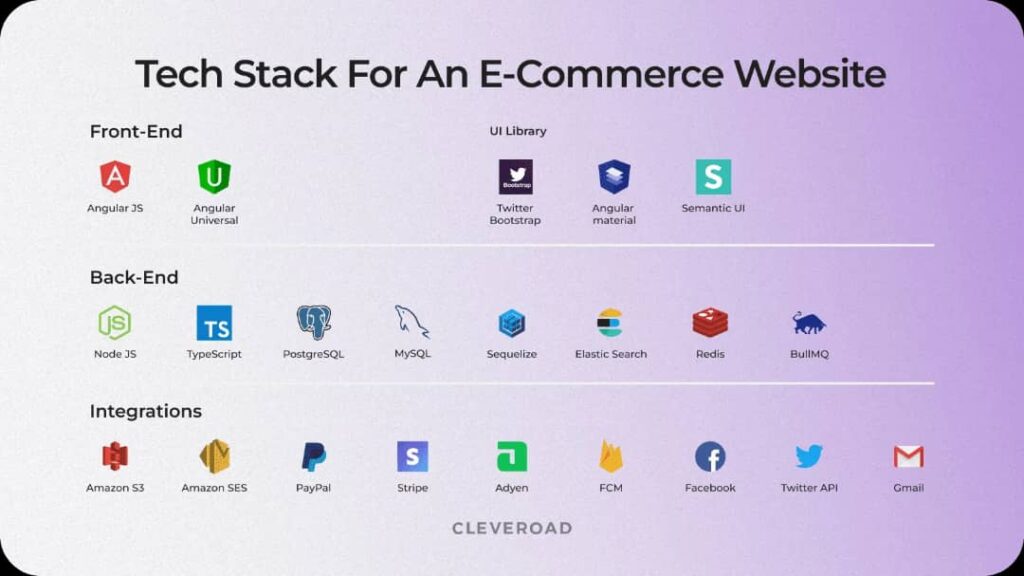
The e-commerce market in Nigeria has grown rapidly in recent years. Rising smartphone usage, improved internet access, and a vibrant fintech ecosystem all contribute. But for Nigerian retailers to truly succeed online, they need more than just a website — they need the right web development stack. The technology behind the store determines how fast it loads, how well it handles traffic spikes, how smoothly it integrates with local payments and logistics, and ultimately whether customers trust and stick with it. In this article, we will examine the optimal web development stack for Nigerian retailers, taking into account the market’s unique realities.
Understanding the E-commerce Web Development Stack
At its core, a “web development stack” describes the set of technologies used to build a website or web application. For an e-commerce site, that typically includes:
- The front-end (what the user sees)
- The back-end (the server logic, APIs, business rules)
- The database/data layer (where products, orders, and user info live)
- The hosting/infrastructure (servers, CDNs, deployment)
- The integrations (payment gateways, logistics APIs, analytics)
- The security & monitoring tools
The stack you choose directly influences user experience (page speed, responsiveness), scalability (can you cope with big sales events?), SEO (can search engines crawl and index you well?), and maintainability (can you update and extend your site without breaking everything?). A “good” stack for one country may falter in another if you don’t account for local context.
The Nigerian E-commerce Landscape: Unique Challenges and Opportunities
Market overview
Nigeria hosts major e-commerce players such as Jumia, which operates a marketplace, logistics and payment network across Africa. Nigeria’s internet user base has expanded, smartphones dominate access, and local fintech solutions (e.g., Paystack, Flutterwave) support growth.
Challenges
Several factors shape technology decisions for Nigerian online retailers:
- Connectivity and power issues: Many users access via mobile networks with variable speeds, and power outages still occur. That means your front-end must perform under less-than-ideal conditions.
- Payment trust: Many consumers remain cautious about online payments — having robust, locally trusted gateways is vital.
- Logistics and delivery: Last-mile delivery remains a challenge; your stack must support real-time order tracking and status updates.
- Mobile-first behaviour: Most users shop on smartphones, so you must prioritise mobile experience.
- Scalability and cost: While you might start small, you’ll want to scale without prohibitive costs or complete rewrites.
Opportunities
- High smartphone penetration creates a large mobile-commerce audience.
- Nigeria’s fintech ecosystem supports seamless local payments.
- A well-optimised site can capture customers underserved by offline retail or older e-commerce players.
Given those points, the right stack must balance modern capabilities with local realities: mobile-first design, performance under limited bandwidth, strong local integrations, and scalable infrastructure.
Core Components of a Successful E-commerce Stack
Before diving into specific technologies, let’s overview the layers every Nigerian retailer should consider:
- Front-end technologies – for fast, responsive user experience
- Back-end frameworks – for logic, APIs, business workflows
- Databases/data management – for products, users, orders
- Hosting & DevOps/infrastructure – for uptime, performance, scaling
- Payment & logistics integrations – critical local factors
- Security & analytics tools – to build trust and drive insights
Each of these layers merits careful selection. Let’s examine them one by one.
Front-End Stack: Building a Fast, Mobile-First Experience
Since many Nigerian shoppers use mobile devices under varying network conditions, your front-end needs to perform well, be responsive, and load quickly.
Recommended technologies
- React.js/Next.js: These frameworks give you component-based architecture, server-side rendering (beneficial for SEO) and can deliver excellent performance. For example, Store Leads shows that Nigerian e-commerce stores use Next.js.
- Tailwind CSS or Bootstrap: These UI libraries help you build consistent, responsive interfaces quickly and maintainably.
- Progressive Web App (PWA): Offering offline caching, push notifications and faster loads, PWAs help when connectivity fluctuates.
- Performance tactics to implement:
- Lazy load non-critical resources (images, scripts)
- Compress images, use WebP or optimised formats.
- Use a CDN to deliver assets fast.
- Minimise JavaScript bundle size
- Ensure responsive images and adaptive layouts
By focusing on front-end performance, you improve user engagement, reduce bounce rates and give mobile users a smoother experience — key in Nigeria’s mobile-first environment.
Back-End Stack: Powering Performance and Scalability
Behind the scenes, your back-end must handle business logic (orders, inventory, payments), provide APIs to front-end/mobile apps, and scale during peak traffic.
Frameworks and approaches
- Node.js (Express.js): Great for JavaScript-centric stacks, offers high concurrency and real-time features (e.g., notifications, chat).
- Laravel (PHP): Popular in Nigeria and familiar to many local developers. Good ecosystem and community support.
- Django (Python): Offers strong security, rapid development and mature libraries. Some Nigerian academic work uses Django for e-commerce.
- Consider a headless architecture: decoupling front-end and back-end allows you to serve multiple channels (web, native mobile) with the same back-end.
- Use API-first design: expose REST or GraphQL APIs so your front-end, mobile app or third-party integrations can all plug in.
Why this matters
- During promotional spikes (e.g., “Black Friday”-style deals), your back-end must scale. As Shopify points out, if you worry about system availability during peaks, your stack is holding you back.
- Scalability ensures you can add new features, such as a mobile app and marketplace modules, without re-architecting the whole system.
Database & Data Management Layer
Reliable data storage and management underpin product inventory, customer profiles, order history and analytics.
Recommended database strategies
- Use PostgreSQL or MySQL for relational data (products, orders, user relationships).
- Use MongoDB (or another document-based DB) if you need flexible schemas, e.g., for varied product types or rapid changes.
- Use Redis or another in-memory store for caching, sessions and high-speed lookups (e.g., recent orders, frequently accessed products).
- Implement backup and redundancy: given local infrastructure challenges, you should plan for data loss prevention and failover scenarios.
A proper data layer ensures you can manage inventory, maintain user sessions, perform analytics and respond to business insights — all critical for online retail success.
Payment Gateways & Local Integrations
For Nigerian retailers, this layer is crucial: you can build the best UI and back-end, but if you cannot process local payments reliably or link with logistics providers, you’ll lose customers.
Payment solutions
- Leverage local payment gateways such as Paystack and Flutterwave. These support NGN, local bank transfers, and card payments and are trusted in Nigeria.
- Integrate payment API securely, ensure you handle webhooks, callbacks, failed transactions and user notifications.
- Maintain compliance with local regulations and ensure data protection for payment information.
Logistics and other integrations
- Use local logistics providers such as GIG Logistics to handle delivery and shipping.
- Integrate SMS/email notifications (e.g., using tools like Termii) so customers get real-time updates on order status.
- Connect analytics tools (e.g., Google Analytics, Meta Pixel) to understand user behaviour and optimise conversion.
Why this layer matters
- Local payment trust can make or break conversions in Nigeria.
- Seamless logistics tracking improves customer satisfaction and retention.
- Analytics and behaviour data help you optimise marketing, stock and pricing.
Hosting, Deployment, and Infrastructure
Your store’s infrastructure must deliver fast load times, high uptime and scale as you grow.
Infrastructure options
- Cloud hosts like AWS or DigitalOcean give you flexibility in Nigeria and globally.
- For front-end deployments, services like Vercel or Netlify provide fast global CDNs and simplified workflows.
- Use a Content Delivery Network (CDN) to serve static assets from locations near users, reducing latency.
- Implement CI/CD pipelines so updates and bug fixes deploy smoothly and automatically.
- Ensure your infrastructure handles high traffic peaks, backups, monitoring and auto-scaling.
Why it’s important
- A slow site will drive away users; performance errors erode trust and hurt sales.
- Reliable infrastructure means fewer outages, fewer delays, and better customer experience even during promotions.
Security and Compliance
In Nigeria’s e-commerce environment, building trust is essential. Security and compliance underpin that.
- Use SSL/TLS for all transactions and data in transit.
- Encrypt sensitive data at rest.
- Ensure PCI DSS compliance (or equivalent) for payment processing.
- Build in multi-factor authentication (MFA) for admin portals.
- Regularly audit your system, patch vulnerabilities and schedule backups.
- Provide transparent privacy policies and protect customer data — the regulatory environment and consumer expectations are rising.
Strong security builds customer trust, reduces fraud risk and safeguards your business reputation.
Case Studies
Let’s look at a prominent example: Jumia.
Jumia is Nigeria’s leading e-commerce marketplace, handling millions of transactions across its ecosystem. Their tech stack includes a heavy use of web analytics, database management and cloud services.
They handle the full purchase funnel — product listing, payments (via JumiaPay), logistics and delivery. They scale infrastructure to handle large traffic volumes. Their marketplace model uses integrations and modular architecture, lending flexibility. While we don’t have full public details of all tech choices, Nigerian retailers can imitate this approach by making use of modular architecture, local payment/logistics integration, mobile-first front-end, and cloud hosting.
A smaller retailer could adopt similar principles on a smaller budget: choose a framework with growth in mind, integrate trusted local payments and logistics from day one, optimise for mobile, and host on scalable infrastructure.
Emerging Trends & Future Outlook
The e-commerce stack that works today will evolve—and Nigerian retailers should keep a forward-looking mindset.
- Headless commerce and microservices: Decoupling front-end and back-end lets you add new channels (mobile app, marketplace) faster and manage updates more safely.
- AI-driven personalisation & chatbots: Using machine learning to recommend products, personalise offers and support customers.
- Blockchain/secure payments: Although still nascent in Nigeria, secure, distributed payments and tokenised systems may become relevant.
- Local developer ecosystem growth & open-source adoption: Nigerian developers increasingly use frameworks like Next.js, React, and Node.js, as the data shows.
- Omnichannel experiences: Blending online and offline, mobile app, social commerce seamlessly—smart stacks make this easier.
In short, pick modern tools now that allow you to adapt and expand, rather than lock you into outdated architectures.
Conclusion
For Nigerian retailers, the “best” e-commerce web development stack comes down to balancing modern performance, local adaptation, scalability and maintainability. A stack built on a mobile-first, fast front-end (e.g., Next.js + Tailwind), a scalable back-end (Node.js, Laravel, Django), reliable database and caching, strong payment and logistics integrations, cloud-based hosting/DevOps, and strict security will position you for success.
As Nigeria’s digital market evolves, continuously optimise your technology, monitor performance, iterate the user experience and stay aligned with local realities (payments, logistics, mobile behaviour). With the right stack and mindset, your online retail venture can thrive.
Need a functional and professionally designed website? Let Bozng help you build a professional, functional, SEO optimized website to grow your business.