
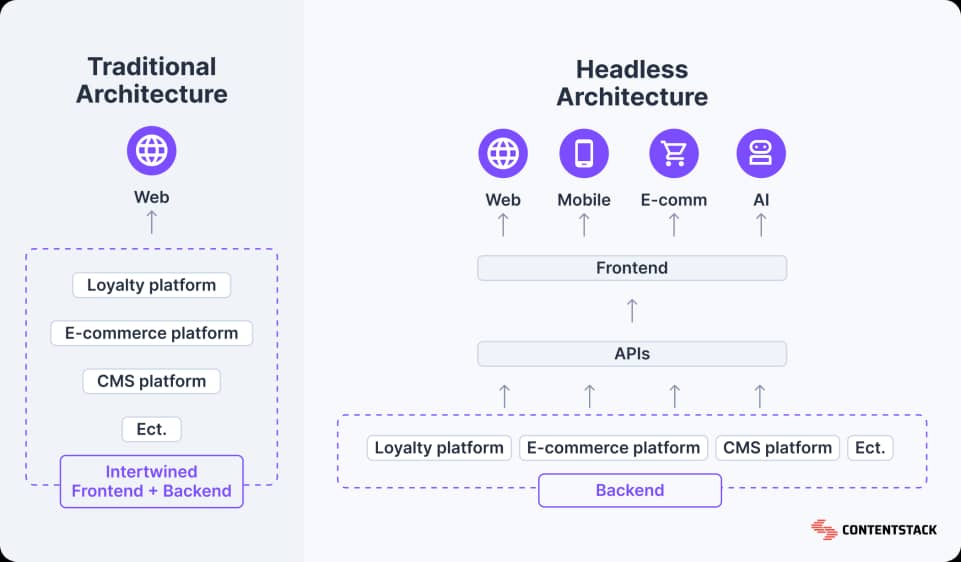
Businesses demand websites and applications that are fast, flexible, scalable and capable of delivering across many channels. At the heart of meeting these demands lies the choice of web architecture. On one side stands the traditional monolithic architecture, which is a single unified system where front-end, back-end and database form one tightly-coupled block. On the other side is the headless architecture, also known as decoupled architecture, where the front-end is separated from the back-end and communicates through APIs, giving developers more flexibility and businesses more freedom.
The question is not simply “Which is better?” but rather “Which fits your business goals, team and roadmap?”
This article examines both architectures, highlights how they differ, explains when each one makes sense, explores hybrid options, and offers a decision framework to help you choose the right approach for your custom web development project.
Understanding Web Development Architectures
Web development architecture refers to the overall structure that governs how different parts of a web application, such as the user interface, business logic, data management, and infrastructure, are organised and interact. That choice influences performance, maintainability, scalability, development speed, and the user experience. When you design a custom web solution, the architecture shapes how easily you can modify or expand features later, how well your site handles surges in traffic, and how smoothly users engage with your content across devices. Therefore, selecting the right architecture matters not only for the initial build but for long-term operations and future growth.
What Is a Monolithic Architecture?
A monolithic architecture arranges the entire application, including the user interface, business logic and data access layers, into a single, cohesive unit. In practical terms, the front-end, back-end and database are tightly coupled. Changes in one area often cascade into others, and deployment happens as one block rather than in independent pieces.
Monolithic architecture offers several clear advantages. Because everything lives in one place, development and deployment can be straightforward. You build fewer moving parts, debugging can be more direct, and testing one integrated unit can prove simpler. For small projects or early-stage applications, that simplicity can save both time and cost.
However, monoliths carry notable limitations. When you need to update or scale one part—say the user-interface layer—it often forces you to redeploy the whole application. Over time, the codebase can become unwieldy. Scaling becomes more complex because you must scale the entire system, even if only one component requires the extra capacity.
Also, because the front and back ends are intertwined, downtime in one subsystem can bring the whole system down. These constraints make monolithic architecture less suited to scenarios where agility, frequent changes or multi-channel delivery matter.
What Is a Headless Architecture?
Headless architecture breaks the tight coupling between how content or business logic is managed (the back-end) and how it is presented (the front-end). The “head” (user interface/presentation layer) is separated from the “body” (content, business logic, database). The back-end exposes data and logic via APIs, and a front-end of your choosing (web, mobile, IoT, etc.) consumes them.
In this setup, developers have the freedom to build the user interface with their preferred frameworks (e.g., React, Vue, Angular) or even switch frameworks over time without having to redo the back-end. Because content is delivered as raw data via APIs, you can reuse it across multiple channels, such as websites, mobile apps, kiosks, and smart devices. That flexibility supports omnichannel strategies. Headless architectures also often support better scalability, and you can scale the back-end independently of the front-end.
That said, headless comes with trade-offs. The decoupling introduces complexity, so you need to configure APIs, manage separate deployments, and build or integrate the front-end yourself. The initial cost and effort are higher. You’ll require a more skilled development team and good architecture governance. Without that, performance or maintainability may suffer. So while headless offers powerful long-term flexibility, it demands more up-front investment.
Key Differences Between Headless and Monolithic Architectures
When you compare monolithic and headless architectures, several major dimensions stand out. Structure is a primary distinction. A monolith embeds front-end, back-end and database together; a headless architecture decouples them, using API-first design to bridge presentation and logic.
In terms of scalability and flexibility, monoliths tend to lag because changing one part often impacts the whole; headless systems allow independent scaling, independent front-end evolution, and multi-channel delivery.
Maintenance differs, too. Monolithic applications can be easier to manage when the system is small and stable—fewer moving parts mean fewer integrations. But as the application grows, maintaining and upgrading becomes harder. A seemingly small change may force a full redeployment or expensive regression testing. Headless architectures, conversely, put more demands on initial design and integrations, but they make iterative changes and evolution easier over time.
Performance is another angle. Monolithic systems may perform well initially, especially for simpler websites, because of fewer network hops and a simpler architecture. But they often hit bottlenecks when traffic surges or when many front-end variants exist. Headless architectures, when executed well, enable optimised front-ends, static site generation, and global CDNs, achieving higher performance for complex needs. That said, headless does not guarantee performance — it still requires careful implementation.
Finally, cost and time-to-market vs long-term ROI come into play. A monolithic build may get you to launch faster and with lower cost initially. A headless build will require more investment upfront, but pays off when you need flexibility, scale and future growth. Think of monolithic as the “get it launched” route and headless as the “future-proof, scalable” route.
When to Choose Monolithic Architecture
Monolithic architecture fits best when you have a small to medium-sized project, relatively stable requirements, and limited need for multi-channel delivery or rapid iteration. If you are building a simple business website, a landing page, or a standard corporate portal which doesn’t require frequent front-end redesigns or third-party integrations, a monolith may offer the right balance of simplicity and cost-effectiveness.
Also, if your team is small, you have a limited budget, or you need to go to market quickly, the monolithic approach reduces complexity. Because everything is in one place, you can develop and deploy faster without managing multiple service layers or integrations. This method is ideal when you do not expect dramatic future changes, heavy traffic surges, complex integrations or multiple device-channel delivery. In that context, a monolith gives you safe, reliable, straightforward delivery.
When to Choose Headless Architecture
You should favour a headless architecture when your project demands high flexibility, scalability, and multi-channel delivery. If you intend to publish content across web, mobile apps, kiosks or IoT devices; if you expect to re-use content, support multiple front-ends, or switch front-end frameworks over time; then headless becomes very attractive. For example, if you manage an e-commerce platform, a global brand website, a SaaS product, or a digital experience platform with evolving UI/UX, headless offers future-proofing.
Additionally, if your business anticipates frequent front-end changes (redesigns, A/B tests, new channels), or you have a development team comfortable with APIs, microservices or modern frameworks, headless gives you the ecosystem to iterate fast. Though the upfront cost and complexity are higher, the return is in agility, broader reach, and lower risk of being locked into a specific presentation layer. Trade-offs include requiring stronger architecture governance, integration expertise and ensuring performance loads across services remain efficient.
Hybrid Approaches: The Middle Ground
Sometimes the binary choice between monolithic and headless feels too strict. Enter hybrid or semi-decoupled approaches, which blend the stability of monoliths with the flexibility of headless systems. In a hybrid setup, you might keep a monolithic backend for core features but decouple the front-end for new consumer-facing channels. Alternatively, you might start with a monolith and gradually transition parts to headless.
This approach is particularly useful when you have legacy systems or incremental transition needs. You may wish to migrate gradually rather than do a full rewrite. It also offers a practical risk-mitigation path: keep what works while modernising where you need flexibility. Choosing a hybrid architecture demands careful governance to avoid creating a messy “two-engine” system, but when done properly, it gives you the best of both worlds: you maintain familiarity and cost-control while enabling future evolution.
Decision Framework: How to Choose the Right Architecture
Selecting the right architecture starts with asking key questions.
- First: What is the size and complexity of your project? If you are building a simple site with stable requirements, monolithic may suffice. If you expect complex features, many integrations, or multi-channel delivery, lean headless.
- Second: What budget and resources do you have? Monoliths often cost less initially; headless demands more development time and expertise.
- Third: What are your scalability and future-proofing needs? If you anticipate growth, traffic surges, new channels, or frequent UI changes, headless offers more headroom.
- Fourth: Do you need omnichannel delivery? If your content must flow seamlessly across web, mobile, smart devices or kiosks, headless strongly edges ahead.
- Fifth: What is your team’s skill set? Headless requires a stronger API, front-end/back-end separation, and service-oriented thinking. Monoliths may be easier for teams working under more constrained resources.
- Finally: How quickly do you need to launch, and what risk are you willing to take? If you need to go live fast with lower complexity and lower risk, a monolithic approach is safer. If you are willing to invest now for long-term flexibility and growth, headless will pay off.
By mapping your answers to these questions, you can chart the architecture that aligns with your business goals and technical capabilities.
Conclusion
The decision between monolithic and headless web development architecture is seldom one-size-fits-all. Monolithic systems offer simplicity, speed to market and lower upfront cost. Headless architectures provide flexibility, scalability, multi-channel reach and futureproofing but require greater effort, expertise and investment. The best choice depends on your project scope, team capacity, budget, product roadmap and channel strategy. If you build a project where requirements are stable, channels are limited, and speed is critical, a monolithic approach may serve you well. If you expect growth, frequent change, multiple touchpoints and want to stay agile, headless is the stronger path. Evaluate carefully, map your architecture decision to your business goals, and pick the model that gives you both an effective launch and a sustainable evolution.
Need a functional and professionally designed website? Let Bozng help you build a professional, functional, SEO optimized website to grow your business.