
Software teams no longer deliver monolithic desktop applications once every few months. Instead, modern development runs at breakneck speed: continuous integration, frequent deployments, microservices, cloud infrastructure, and fast feedback loops. In such an environment, security can no longer sit at the end of a checklist, waiting until release day.
That’s where DevSecOps comes in.
DevSecOps treats security not as an afterthought or a final gate, but as an integral part of the entire development lifecycle. By shifting security to the left (and keeping it present even after deployment), teams reduce risk, speed up delivery, and build more resilient systems from day one.
In this article, I’ll walk you through why shifting security earlier matters, how to implement security into every phase of development, what tools and practices help achieve that, and how to build the right culture to sustain DevSecOps long-term.
The Problem with Traditional Security Models
Traditional software security often lives at the end, when everything else is “done.” Developers write code, run functional tests, then hand over to security or QA teams for vulnerability scans, penetration testing, or compliance checking. Sometimes, security only happens right before deployment.
That model creates problems. First, it introduces risk: vulnerabilities found late may have spread across many modules, become deeply embedded, or even reached production without detection. Fixing such flaws usually means reworking code, re-testing, or even rolling back deployments — which costs time and money.
Second, traditional security slows down delivery. Last-minute security reviews or fixes often block releases, creating friction between fast-moving development teams and slow, methodical security teams.
Third, it encourages a “patch-and-fix” mentality rather than a “build secure from the start” mindset. Developers often prioritise features over safety, and security becomes a burden — or worse, an afterthought.
DevSecOps: Security as First-Class Citizen
DevSecOps rewrites that story. It treats security as a shared responsibility across development, operations, and security teams. It embeds security practices — automated and manual — throughout the development lifecycle, rather than leaving them to the end.
By doing so, teams catch vulnerabilities sooner, reduce rework, and deliver features faster without compromising security. Security becomes an enabler, not a bottleneck.
What Makes DevSecOps Work
Automated security scans and continuous testing.
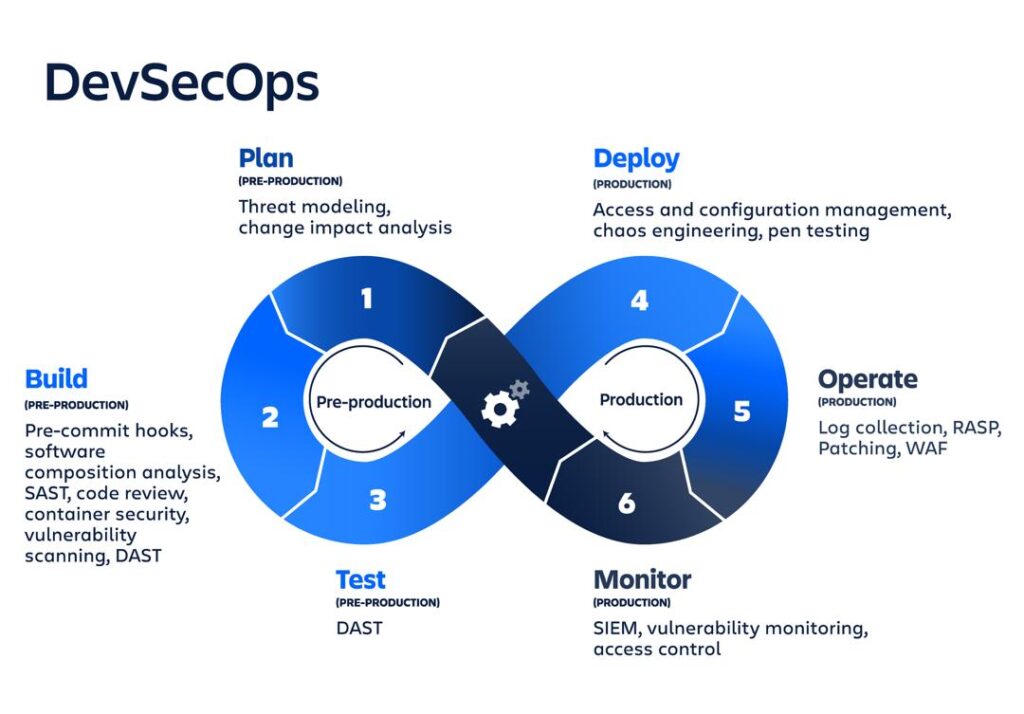
As soon as developers push code, automated scanners check for vulnerabilities. Static code analysis (SAST) detects issues such as injection risks or insecure coding patterns before compilation. Software composition analysis (SCA) inspects dependencies and open-source libraries for known vulnerabilities. Infrastructure-as-Code (IaC) templates get scanned before provisioning. Container images get vulnerability-checked before deployment. Later, dynamic testing (DAST) or runtime monitoring finds flaws that only appear in running apps, such as misconfigurations or unexpected behaviours.
Policy-as-code and infrastructure security by default.
Rather than manually verifying configuration, teams embed policies directly into code. For IaC, this may mean requiring encryption, limiting access, or enforcing secure network rules. The system automatically rejects non-compliant infra or flags misconfigurations before deployment.
Continuous monitoring and runtime defence.
DevSecOps doesn’t stop at deployment. It monitors live systems, tracks logs, observes behaviour, and flags anomalies, providing teams with real-time visibility into their security posture. That way, if something goes awry in production, teams spot it quickly and respond.
Shared responsibility and security-aware culture.
Developers, ops, and security engineers collaborate. Developers follow secure coding practices. Infrastructure folks ensure hardened configurations. Security teams provide oversight, tools, and guidance. Security becomes part of everyone’s daily workflow, not a separate phase or gate.
Faster delivery with lower risk.
By shifting security early and automating scans, teams avoid last-minute bottlenecks. They discover and remediate flaws before they reach production. They deploy faster, with better confidence and fewer surprises.
Weaving Security into Every Phase of Development
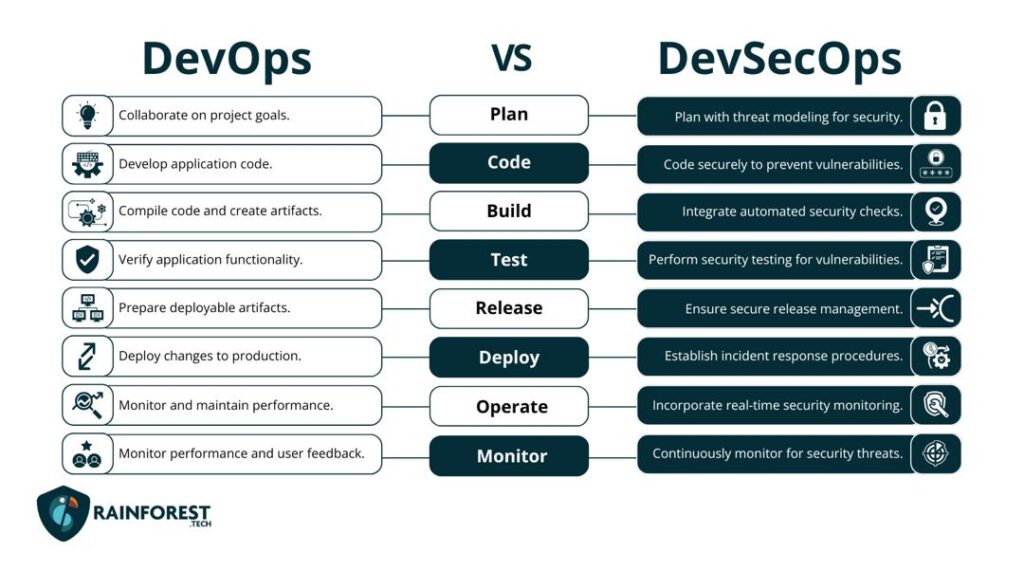
Adopting DevSecOps means rethinking how security fits into every stage of your software lifecycle. Here’s how to do it — from planning to runtime operations.
Planning & Design
From the start, treat security as a requirement. During design or sprint planning, include security-related user stories, threat modelling, and risk assessment. Elevate security requirements alongside functional ones. This helps teams plan features with security baked in — not as an afterthought. Architects and engineers should identify potential attack vectors, data flows, and sensitive boundaries long before writing the first line of code.
Coding & Development
Encourage secure coding standards. Use static analysis tools to catch common flaws (like injection vulnerabilities, insecure handling of secrets, or weak input validation) even before code leaves a developer’s machine or hits the central repository. Adopt dependency hygiene: scan third-party libraries for known vulnerabilities, and treat updates or patches as first-class work. For infrastructure code, scan IaC templates to prevent misconfigurations, insecure permissions, or mis-provisioned resources.
Build & CI Pipeline
Every time developers merge code, they trigger automated scans. Integrate SAST, SCA (dependency scanning), IaC scanning, and container image scanning into the CI/CD pipeline. If any high-severity issue arises — block the merge. Provide immediate, actionable feedback within the workflow so developers can fix issues before they grow. This fast feedback loop encourages secure coding habits and reduces friction.
Testing & Pre-deployment
After build but before deployment, run dynamic application security testing (DAST) on staging environments. Probe running applications for runtime vulnerabilities, misconfigurations, or security gaps that static analysis might miss. Combine DAST with interactive testing (IAST) or manual penetration testing where needed — especially for critical systems. Ensure compliance checks run automatically too: embed company or regulatory standards (e.g. encryption mandates, access controls, audit logging) as code or pipeline policies so you never ship non-compliant systems.
Deployment & Release
When you deploy, make your pipeline “secure by default.” Use container or image scanning before deployment. Enforce immutable infrastructure policies so deployments always start from a known secure baseline. Ensure access controls (least privilege, role-based access) apply to deployment systems, secrets are properly managed (not hard-coded), and deployment configurations follow security policies.
Runtime & Operations
Security doesn’t end at deployment. Monitor systems continuously. Use logs, metrics, alerting, and runtime protection tools (such as runtime application self-protection, RASP). Detect anomalies, misbehaviors, or suspicious events. Correlate alerts across infrastructure, applications, and network — so teams get early warning before an exploit becomes a breach. Review and update threat models regularly. Adapt to new dependencies, changing infra, and evolving threat landscapes.
The Tools and Practices That Power DevSecOps
Implementing DevSecOps doesn’t require reinventing the wheel. Several mature tools and practices make integration smooth. Static analysis platforms like SAST tools catch code-level vulnerabilities early. Dependency analysis (SCA) tools scan libraries for known CVEs. IaC scanners inspect infrastructure-as-code templates for misconfigurations before provisioning. Container image scanners inspect Docker or OCI images for outdated packages or security flaws. For runtime, monitoring stacks or RASP solutions watch live traffic and behaviour. Many teams combine these with build pipelines (CI/CD) to run scans automatically on commits, merges, or deployments.
Beyond tools, embed “policy-as-code”: codify your security standards (access control, encryption, compliance rules), and enforce them automatically during infra provisioning or deployment. Treat compliance as part of your pipeline, not a manual audit at the end.
Automating incident detection and response also helps. With continuous monitoring and logging, your team can detect anomalies in real time and respond quickly — dramatically reducing the window of exposure if something goes wrong.
Building the Right DevSecOps Mindset
Technology alone doesn’t deliver DevSecOps. You must nurture a culture where security becomes part of every developer’s job. That starts with shared responsibility: developers write secure code, ops ensure infrastructure stays hardened, and security engineers build tools, guardrails, and oversight.
Train your developers. Secure coding practices matter. Encourage them to think about input validation, secrets handling, error handling, encryption, and safe dependencies. Reward secure behavior — not just functional output.
Encourage collaboration. Make security part of planning, daily stand-ups, and reviews. Don’t relegate it to a separate “security phase.” Let security champions emerge — developers who care about safety and help others understand best practices.
Treat security as a continuous journey. Threats evolve, infrastructure changes, and dependencies update. Encourage periodic reviews: re-run threat modelling, re-scan dependencies, re-assess runtime monitoring. As projects evolve and scale, so must your security posture.
Why DevSecOps Pays Off
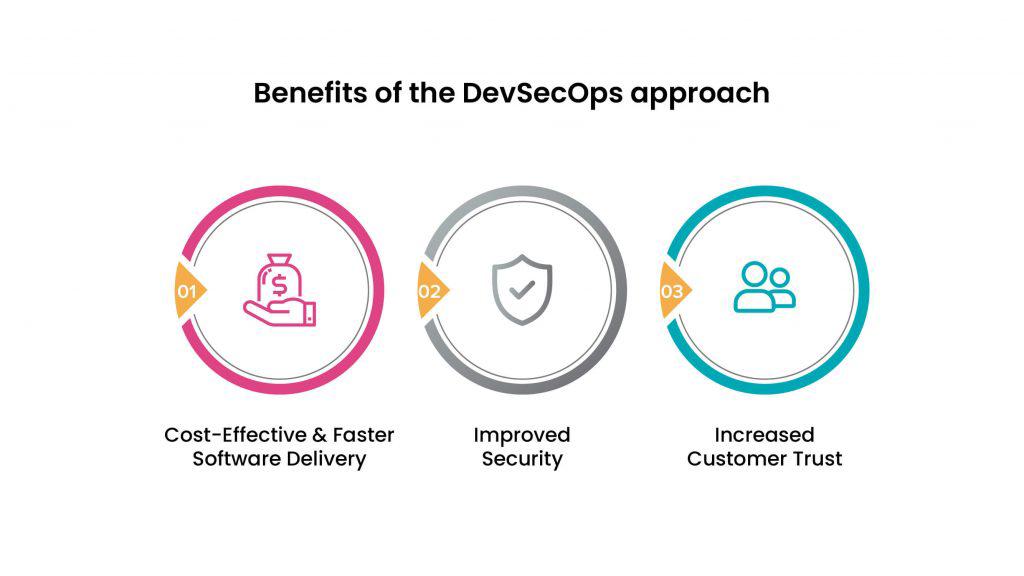
When you embed security early and automate checks throughout the lifecycle, you reduce risk dramatically.
- You catch vulnerabilities before they reach production. You avoid expensive reworks and emergency patches. You keep compliance and reduce audit headaches.
- You also improve velocity. By removing security as a bottleneck, you deliver features faster and more reliably. Security becomes an enabler, not a blocker.
- Your developers become more confident. They build with security in mind, avoid common pitfalls, and deliver higher-quality, more resilient software.
- And your organisation becomes more resilient. With automated compliance, consistent infrastructure, continuous monitoring, and shared ownership, you build systems that can withstand threats — even as your software evolves and scales.
Challenges & How to Overcome Them
Implementing DevSecOps isn’t always easy. People resist change. Teams struggle with tool overload. Developers may complain about noise from security scanners. Legacy systems or infrastructure-as-code scripts may contain messy configurations.
Overcome this by starting small and incremental. Begin with the highest-impact, lowest-friction practices: integrate static code and dependency scanning into your CI pipeline. Add IaC scanning for infrastructure. Then expand to container image scans, DAST, runtime monitoring, and policy-as-code.
Focus on feedback and tuning. Tune security tools to reduce false positives. Provide clear, actionable feedback. Adjust thresholds so only real issues block the build. Avoid overwhelming developers.
Promote culture, not just tools. Offer developer training. Encourage ownership. Celebrate wins when security incidents don’t happen because early detection worked. Build a shared understanding that security supports — not hinders — delivery.
Conclusion: DevSecOps Is Not a Project — It’s a Discipline
Adopting DevSecOps isn’t a one-time project or checkbox. It’s a long-term commitment, a discipline. It requires integrating security into how you plan, code, build, test, deploy, and operate software. It demands collaboration, automation, and continuous vigilance.
But if you do it right, the payoff is huge. You build faster, safer, and with more reliable software. It also helps reduce risk. You safeguard users. You enable innovation without compromising security.
In today’s fast-paced, threat-filled world, DevSecOps doesn’t just make sense — it becomes essential.