
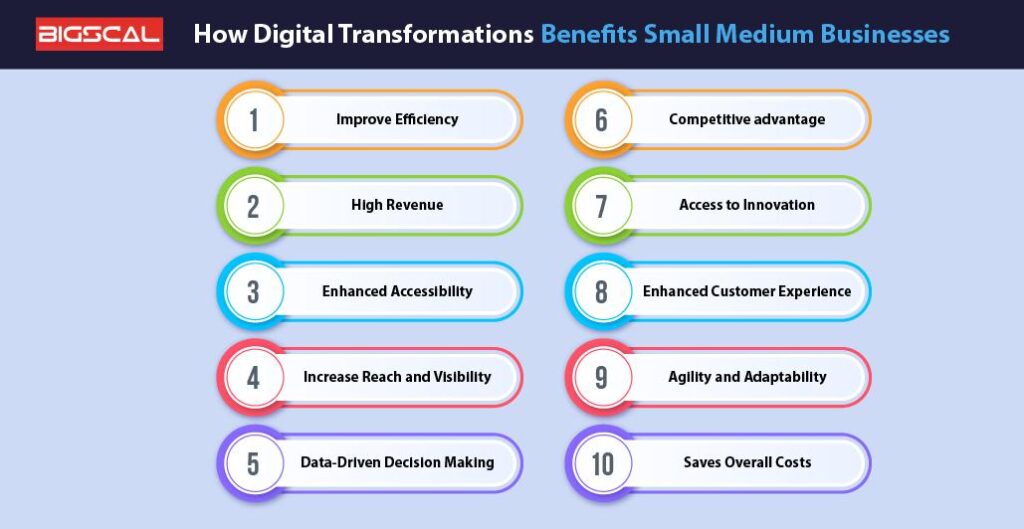
Small and medium-sized businesses (SMBs) often find themselves at a disadvantage when they measure against large enterprises: limited resources, smaller teams, and ever-growing customer expectations. But today, digital transformation offers SMBs a real chance to level the playing field. By embracing cloud computing, data analytics, and artificial intelligence (AI), smaller businesses can run smarter, serving customers better and moving faster, all without needing enterprise-size budgets.
This article walks you through why this transformation matters, how to approach it strategically, and what you can realistically achieve.
Why Digital Transformation Matters for SMBs
In a world where customer expectations surge and markets evolve rapidly, digital tools no longer represent a luxury — they signal a necessity.
- SMBs that embrace cloud, analytics, and AI enjoy the benefits of better productivity, greater flexibility, and the ability to pivot with market changes. MDPI’s review of SME cloud adoption found that about 82% of studies reported improved operational efficiency, and 76% saw cost savings.
- For SMBs under pressure from bigger competitors, digital transformation becomes a force multiplier. With modest investment, they can access powerful tools that previously only large firms could afford. Many SMB leaders recognise that digital technology reshapes operations, customer interaction, and growth potential.
- Technology levels the playing field. Cloud-based services and AI no longer require massive infrastructure. Smaller firms can now tap into scalable, modern computing and compete more effectively.
In short, digital transformation helps SMBs survive and thrive in a world shaped by speed, data, and customer-first mindsets.
Begin By Knowing Where You Stand
Before investing in tools or technologies, businesses need clarity. Transformation without a realistic view often leads to wasted efforts.
Ask yourself:
- What parts of your operations rely heavily on manual work or outdated tools?
- Where do you see bottlenecks — in customer service, inventory, scheduling, reporting, or decision-making?
- Does your team have the mindset and willingness to learn new tools and workflows?
- What business goals are most urgent — cost-cutting, expansion, improved customer experience, faster delivery?
Taking stock of your current state — technology, people, processes, and priorities — lays the foundation for a smart transformation plan.
Build a Strategic Roadmap
Don’t chase every trend. Jumping headfirst into every new tool may overwhelm resources and backfire. Instead, build a roadmap rooted in business needs, not buzzwords.
- Prioritise high-impact areas. Focus first on functions that cause friction or drain resources, like customer support, manual invoicing, or inventory management.
- Start with small pilot projects. Choose one or two initiatives that deliver visible gains quickly. Early success builds momentum and confidence.
- Budget and resource wisely. Recognise that transformation requires investment — but cloud-based and pay-as-you-go models reduce up-front costs.
- Phase your efforts. Begin with tools that automate or simplify earlier: cloud hosting, SaaS applications, basic analytics or AI tools. Once the business gains familiarity and confidence, expand the scope. This approach echoes frameworks recommended for gradual AI and digital adoption.
This roadmap protects you from overcommitting, avoids the risk of “digital overwhelm,” and ensures that investments deliver real business value.
Cloud: The Digital Foundation That Powers Transformation
Adopting cloud computing represents the essential first step for most SMBs. Cloud unlocks scalability, flexibility, and access to powerful infrastructure that used to be feasible only for big companies.
- Scalability and elasticity: Cloud services let businesses scale resources up or down depending on demand. That means no overpaying for unused capacity, but also no shortage when business surges.
- Faster deployment and agility: Rather than installing and maintaining hardware internally, cloud lets you launch applications, services, and updates faster. That reduces time-to-market and speeds up experimentation.
- Lower entry cost: Traditional IT infrastructure requires capital investment, but with cloud, companies pay-as-you-go. For many SMBs, this makes technology adoption more financially viable.
- Access to advanced tools: Cloud platforms often come bundled with powerful tools, such as storage, analytics engines, AI services, and collaboration suites, giving SMBs enterprise-grade capabilities without needing to build from scratch.
In effect, cloud becomes the backbone of your digital transformation — the base on which analytics and AI can run reliably and cost-effectively.
Turning Data into Decisions
Once you deploy cloud and start collecting data, such as sales numbers, customer interactions, and inventory flow, the next step lies in turning that data into insight. That’s where analytics comes in. Traditional decision-making often relies on gut feeling or hindsight; analytics shifts the narrative to data-driven foresight:
- Businesses can centralise their data in cloud-based repositories, eliminating data silos and enabling unified visibility into operations.
- With analytics tools accessible even to non-technical staff, SMBs can interpret trends, uncover inefficiencies, and understand customer behaviour.
- Analytics supports smarter forecasting for sales, inventory demand, and seasonal trends, enabling better planning, reducing wastage, and improving readiness.
Analytics brings clarity. It helps SMBs answer questions such as: which products sell best, when customers engage most, where we lose money, or how to optimise operations. These insights guide smarter decisions.
Deploying AI, The Competitive Equaliser
For SMBs, AI stops being a luxury and becomes a powerful equaliser. Many modern AI tools build on cloud infrastructure and analytics, offering automation and predictive capabilities without requiring large engineering teams.
What AI can do for SMBs
- Automate repetitive administrative tasks, such as scheduling, invoice generation, and simple customer queries, freeing human energy for creative and strategic work.
- Deliver personalised customer experiences. AI-powered chatbots or virtual assistants can provide instant responses, customised suggestions, and 24/7 customer support — helping build loyalty and trust.
- Offer predictive insights: demand forecasting, customer segmentation, inventory optimisation, trend analysis, enabling SMBs to act proactively rather than reactively.
- Increase overall efficiency and reduce costs. Many SMBs report that AI improves productivity and cuts overhead. According to one global survey, 91% of SMBs using AI say it boosted their revenue.
How to Adopt AI Strategically
You don’t need to build custom AI models from day one. Start small and practical:
- Use off-the-shelf cloud-based AI services (chatbots, predictive tools, analytics) to handle common needs like customer support or marketing. These services often have pay-as-you-go pricing and built-in support — perfect for smaller budgets.
- Pilot AI in one function first — for example, customer service automation — measure impact, get team buy-in, then expand. This approach minimises risk and lets you refine processes.
- As your organisation gains maturity, consider more advanced AI, such as predictive analytics, demand forecasting, or even custom AI workflows, provided your data, infrastructure, and team readiness support it.
A phased, thoughtful approach avoids wasted spending, reduces disruption, and builds confidence as your team learns and adapts.
Security, Data Privacy, and Governance
Digital transformation brings power, but also responsibility. As you adopt cloud, analytics, and AI, you need to treat data security and governance seriously.
- Cloud providers deliver strong security tools, such as encryption, access controls, and multi-factor authentication, but you must configure them properly.
- As you collect customer data, ensure you respect privacy laws and industry best practices. Data ethics and security must stay central.
- Build a culture of accountability: assign roles for data governance, ensure clear procedures, and train staff in safe data handling.
Smart security and governance preserve trust — both internally and with customers — and prevent costly compliance or breach issues down the line.
People, Processes, and Culture Matter
Technology alone doesn’t transform a business. People do. For SMBs adopting new tools and systems, managing change carefully makes the difference between success and failure.
- Communicate the vision clearly. Explain why transformation matters, what benefits to expect, and how team workflows may change.
- Train and support employees. Provide learning opportunities, encourage experimentation, and create a feedback culture.
- Start small and build gradually. Launch pilot projects, gather lessons, iterate — this builds confidence and reduces resistance.
- Encourage a growth mindset. Frame transformation is an ongoing journey, not a one-time fix.
When your team embraces change, digital tools become enablers — not burdens.
Measuring Success: Key Metrics to Track ROI
To ensure transformation delivers value, track concrete metrics, such as:
- Operational efficiency: time saved, reduction in manual tasks, faster delivery cycles.
- Cost savings: lower infrastructure costs, reduced headcount or overtime, fewer errors or waste.
- Revenue and growth: increased sales, improved customer retention, expanded market reach.
- Customer satisfaction: faster response times, better service quality, personalised experiences.
- Agility and scalability: ability to scale operations up/down, faster new product or service rollouts.
Use these metrics to evaluate pilot projects, justify further investment, and refine your roadmap.
What’s Next for SMBs Embracing Digital Transformation
The pace of technology innovation keeps accelerating. SMBs that build cloud, analytics, and AI foundations now prepare to benefit from emerging trends:
- Generative AI, automation, and real-time analytics will continue pushing expectations for speed, personalisation, and responsiveness.
- Low-code/no-code tools, AI-as-a-service offerings, and improved cloud platforms will make advanced tech even more accessible.
- Data-driven decision making will become the norm — businesses that ignore data risk falling behind.
- Customer expectations will rise: instant support, personalised experiences, seamless digital interactions — SMBs must stay ready.
If you position your business thoughtfully today, you’ll stand ready for tomorrow’s opportunities.
Conclusion
For many SMBs, digital transformation marks the difference between stagnation and growth. Cloud, analytics, and AI give smaller businesses a way to compete — not by scale, but by agility, insight, efficiency, and customer focus.
You don’t need to overhaul your entire operations overnight. Start small, stay strategic, prioritise high-impact areas, and build on each success. Over time, you will transform not just your technology, but your business model, your efficiency, and your competitive edge.
Take that first step today. Begin with readiness, plan carefully, and deploy thoughtfully. Digitally empowered SMBs don’t just survive — they win.