
The web keeps changing, and so do the tools we use to build it. What started as simple scripts to enhance static pages has grown into a thriving ecosystem of frameworks, each shaping how we build modern applications. Over the years, developers moved from raw Document Object Model (DOM) manipulation to structured UI libraries — and now we’re entering a phase where performance, developer experience, and architectural elegance all matter.
In this article, we explore how frontend frameworks evolved, what makes today’s top frameworks powerful, and why a new generation of lightweight, high-performance frameworks is gaining momentum.
From Simple Scripts to Component-Driven UIs
In the early days, building interactive web pages often meant sprinkling vanilla JavaScript or jQuery across HTML. Developers directly manipulated the DOM, leading to code that was hard to manage and scale.
As web apps grew more complex, a new pattern emerged: components. Components let developers bundle UI, logic, and state together, and then reuse them. Suddenly, building large, dynamic user interfaces got much easier.
Alongside components came declarative UIs: instead of describing how to mutate the DOM step by step, developers describe what the UI should look like depending on state, and let the framework handle the rest. This shift made UIs more predictable, easier to reason about, and more maintainable.
As complexity increased, frameworks began adding abstractions around routing, application state, and build tooling. The result is modern frontend frameworks designed for building scalable, interactive, maintainable applications.
The “Big Three” and Their Modern Identity
React
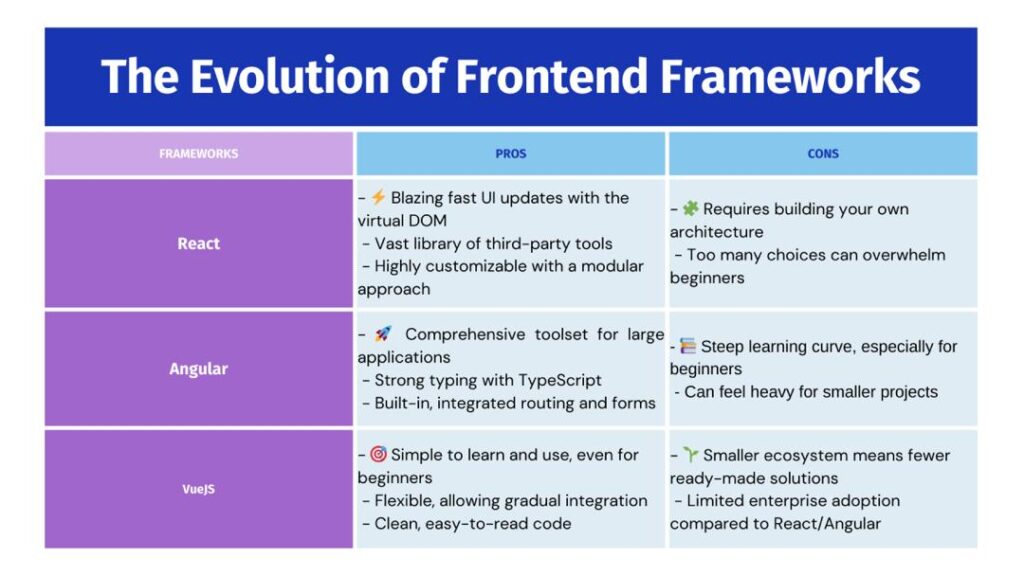
React introduced a component-based UI model with a Virtual DOM. Virtual DOM enables React to create a lightweight representation of the real DOM, diff changes, and update only what needs updating, thereby enhancing performance when updating the UI. Over time, React grew through community-driven tools and libraries. It became less of a framework and more of a foundation, giving developers flexibility to build their own architecture (state management, routing, SSR, etc.).
In recent years, React added powerful features: for example, support for server-side rendering and hybrid rendering via server components. This enables apps to render some parts on the server, improving load time and SEO.
React appeals especially to large teams or projects needing flexibility. Its huge ecosystem, wide community support, and mature tooling make it a safe, reliable choice.
- Strengths: Ecosystem maturity, flexibility, vast community, good for large/complex apps.
- Trade-offs: Because React is unopinionated, you often need additional libraries/configuration (routing, state, SSR) to assemble a full app. Depending on the setup, bundle size, and performance, these can become concerns.
Vue.js
Vue.js is an approachable, balanced, and progressively powerful framework that started with a simple yet powerful idea: provide a declarative, component-driven UI framework that remains flexible and easy to adopt. The core library focuses on the view layer, with optional add-ons for routing, state management, and tooling. Over time, Vue evolved, with Version 3 introducing the Composition API. This gave developers more flexibility in organising logic, better code reuse, and improved TypeScript support.
Vue remains relatively lightweight: its core remains small, and with modern tools (like Vite), development experience is smooth with fast build times and hot module replacement.
On the rendering side, Vue still uses a virtual DOM. But improvements over time — both in rendering pipeline and tooling — help keep performance strong while keeping developer ergonomics friendly.
- Strengths: Gentle learning curve, strong balance between simplicity and power, good for small-to-medium teams or fast-moving projects.
- Trade-offs: Compared with React’s ecosystem, Vue’s community and third-party ecosystem remain smaller (though healthy); for highly opinionated or enterprise-scale needs, you may need add-ons for full features.
Angular
Unlike React or Vue, which focus primarily on the view layer, Angular offers a full framework that brings built-in solutions for routing, dependency injection, forms, testing, and more. That out-of-the-box completeness appeals to large teams building long-lived, complex applications. Angular emphasises structure, consistency, and TypeScript-first development, which lends well to maintainable, scalable codebases, especially in enterprise contexts.
In recent updates, Angular improved performance and developer experience. For instance, newer versions introduced more efficient rendering and ideas like “zoneless change detection” and reactivity improvements to reduce overhead.
- Strengths: Comprehensive toolset, consistency, enterprise-readiness, strong architecture for large apps.
- Trade-offs: Steeper learning curve, heavier abstractions, sometimes more boilerplate — which may feel heavy for small teams or quick projects.
The New Wave of Lightweight, Compiler-Driven & Performance-First Frameworks
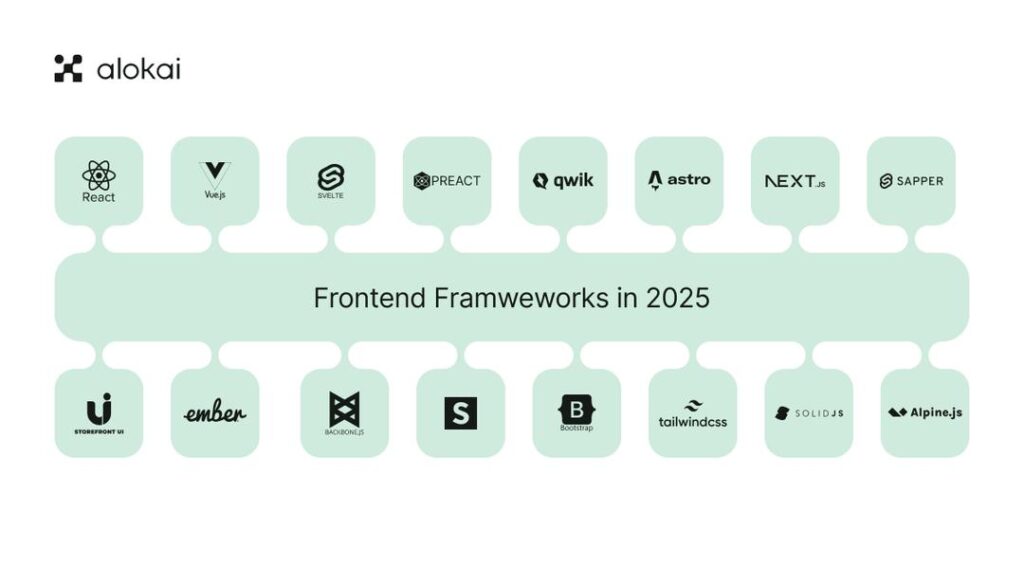
As web apps grow, performance and loading speed matter more than ever, especially for content-heavy or resource-constrained devices. This urged developers to question the traditional frameworks’ runtime overhead. In response, new frameworks emerged that rethink reactivity, rendering, and bundle size.
Svelte
Svelte rejects the classic runtime-based model. Instead of shipping a full framework to the browser, Svelte compiles your components at build time into highly optimised vanilla JavaScript. The results are minimal runtime overhead, direct DOM manipulation, and significantly smaller bundle sizes. Because Svelte removes the virtual DOM abstraction and just outputs efficient code, Svelte apps often load faster and run smoother — especially on low-powered devices or slow networks.
Svelte also bundled a pleasant developer experience: simple syntax, reactive declarations, and less boilerplate compared to many traditional frameworks. Its companion meta-framework (SvelteKit) supports server-side rendering (SSR), static site generation (SSG), and modern deployment workflows.
Because of those strengths, Svelte shines for small-to-medium projects, content sites, or applications where performance and load time matter — static sites, SPAs, or progressive web apps.
SolidJS
Another rising star is SolidJS. Solid blends some of React’s syntax (JSX) with a reactivity model reminiscent of Svelte’s, but with a twist. Instead of virtual DOM diffing, Solid applies fine-grained reactivity, updating only the exact parts of the DOM that change.
This means updates become extremely efficient. On heavy UI workloads or real-time apps (dashboards, data-heavy interfaces), Solid’s performance shines. For developers used to React, Solid feels familiar but with far less runtime overhead.
SolidJS appeals especially when you need performance + modern syntax + small bundle size.
Qwik, Islands Architecture, and the Server-First Movement
- Qwik aims to rethink hydration and interactivity by enabling “resumable” apps. Rather than shipping a big JS bundle, Qwik serialises application state and resumes on the client — avoiding expensive hydration. This can make Time-to-Interactive (TTI) exceptionally fast, even for large apps.
- Meanwhile, meta-frameworks and architectural patterns such as “islands architecture” gain traction: frameworks like Astro let you ship mostly static HTML by default, and hydrate only interactive parts when needed. This dramatically reduces JS payload, improving load times and performance for content-heavy sites (blogs, docs, marketing sites).
These innovations reflect a broader shift. Rather than pushing heavy client-side JS by default, modern development often aims for server-first rendering, static generation, and minimal client JS, while still preserving interactivity where needed.
Common Architectural Patterns & Rendering Strategies
As frameworks evolve, several architectural patterns have become common — but each framework adopts or emphasises them differently:
- Rendering strategies: client-side rendering (CSR), server-side rendering (SSR), static site generation (SSG), or a hybrid. Newer frameworks allow fluid mixing (some parts are server-rendered, other parts are hydrated).
- State/reactivity models: from global stores, observable patterns or hooks (classic) to fine-grained signals/atoms/computed values (modern frameworks). This shift improves performance, predictability, and modularity.
- Compilation vs Runtime: compile-time frameworks (like Svelte, Solid, Qwik) produce optimised vanilla JS. Runtime frameworks (React, Vue, Angular) carry abstraction layers, offering flexibility but sometimes at a runtime cost.
- “Islands” & partial hydration: Rather than hydrating the full page, only interactive bits hydrate. Static content remains static. This reduces JS payload and improves performance, especially for content-heavy or static sites.
These architectural patterns reflect the growing emphasis on performance, speed, and efficient resource use without sacrificing developer ergonomics.
So, What’s Driving This New Generation?
Several forces push web development toward lighter, faster, more efficient frameworks:
- Performance matters more: With mobile usage, slow networks, and SEO concerns, page load time and time-to-interactive are critical. Delivering minimal JS and faster interactivity becomes a competitive advantage.
- User and resource constraints: Many users are on older devices, slower networks, or have limited compute power. Lightweight frameworks help deliver a smooth experience to a broader audience.
- Scalability and maintainability: Apps grow. Frameworks with clear architecture, modular components, and efficient reactivity make long-term maintenance easier.
- Developer experience & productivity: Simpler syntax, less boilerplate, easier builds — frameworks like Svelte and Solid improve DX while still delivering high performance.
- Flexibility in rendering: Modern hosting (edge, serverless) and modern build pipelines allow server-first or static-first rendering — frameworks that support hybrid rendering suit this environment well.
How to Choose the Right Framework
No single framework fits all projects. Instead, the “right” choice depends on:
- Project type: Static blog, e-commerce, real-time dashboard, enterprise web app, content-heavy site, etc.
- Performance requirements: Do you need fast load times, minimal JS, good SEO, smooth interactions on low-end devices?
- Team size and expertise: Big team with need for structure → Angular/React. Small team or solo dev → Vue, Svelte. Performance-focused or experimental → Svelte, Solid, Qwik.
- Ecosystem needs: Do you need lots of libraries, integrations, or third-party components? Then mature ecosystems (React, Vue, Angular) shine. If you value minimalism and performance over breadth, lighter frameworks win.
- Long-term maintenance vs speed-to-market: Enterprises often prioritise long-term maintainability and consistency. Startups or prototypes may value simplicity and speed.
What the Future Holds
Looking ahead, trends suggest:
- More compile-time frameworks — as developers increasingly value performance, minimal runtime overhead, and small bundle sizes.
- Server-first & hybrid rendering dominating — SSR, SSG, islands architecture, resumability become standard practice rather than niche solutions.
- Fine-grained reactivity and signal-first architectures — as seen in Solid, Qwik, and upcoming versions of classical frameworks, for predictable, efficient UI updates.
- Flexibility & interoperability — metadata frameworks, the ability to mix multiple frameworks/components in one project, plus integration with edge/SSR hosting, will grow.
- Developer tools, TypeScript, and modern build pipelines will improve, making new approaches accessible without sacrificing productivity or developer experience.
Conclusion
Frontend development has come a long way. We moved from manual DOM manipulation to reactive, component-based UI libraries; from monolithic frameworks to modular, flexible architectures; and now to compiler-driven, performance-first frameworks.
Depending on your project needs — complexity, team, performance, longevity — there’s a framework that fits. The beauty of this evolution is choice. Developers no longer have to compromise strongly between performance, development speed, and maintainability. Instead, the tools adapt to the project’s needs.