
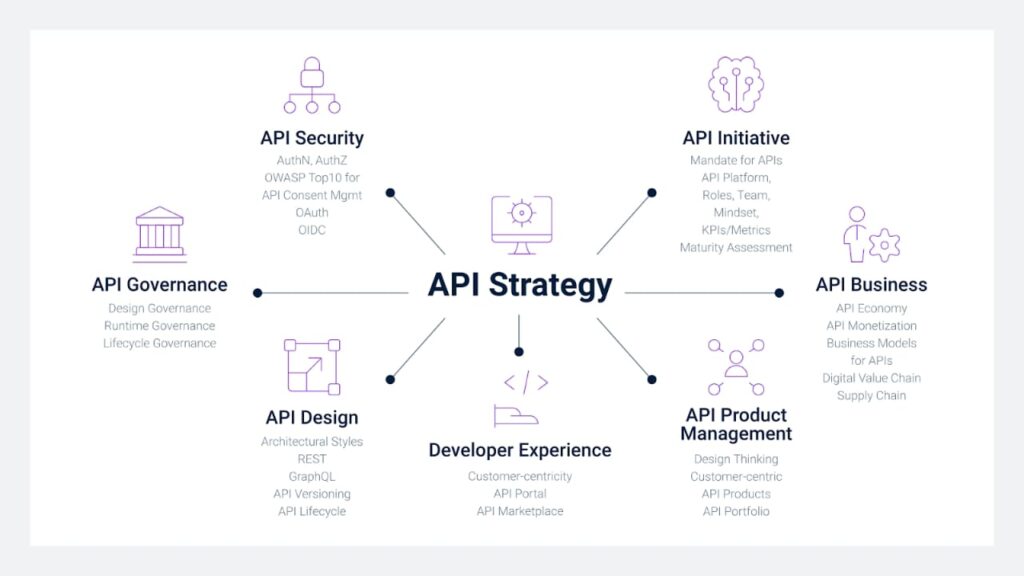
Digital transformation demands flexibility. As businesses scale, launch new channels, or integrate with partners, legacy monolithic systems often prove too rigid. They hamper innovation, slow down development, and make adaptation costly. That’s why many organisations now embrace an API-first strategy that is designed and built around APIs from the start.
Adopting an API-first mindset positions APIs not as afterthoughts or cobbled-on extras, but as foundational building blocks for a modular, scalable, interoperable digital ecosystem. This approach unlocks agility, reusability, and long-term resilience.
In this article, I explore what API-first really means, how it underpins a flexible digital ecosystem, what core components matter, and how to implement it successfully — all while avoiding common pitfalls.
What “API-First” Means
When a team adopts an API-first approach, they treat APIs as first-class citizens. They design the API interface first, including its data contracts, expected behaviours, authentication, error handling, and documentation, before writing the actual service implementation. This contrasts sharply with the traditional “code-first, API-later” approach.
By defining APIs upfront, organisations create a clear, consistent “contract” that all clients and services consume. That contract becomes a stable foundation across web apps, mobile apps, partner integrations, and third-party services. The result: components remain loosely coupled, yet highly interoperable across languages, platforms, and deployment environments.
This philosophy matters because it unlocks:
- Modularity and reusability — APIs expose discrete business capabilities (e.g. “get customer profile,” “process payment,” “submit order”) that teams can reuse across projects.
- Platform-agnostic integration — Because APIs adhere to standardised protocols (e.g. REST, GraphQL, gRPC), clients with different technologies can interact seamlessly.
- Parallel development and faster delivery — Front-end, back-end, QA, and third-party integrations can proceed in parallel, thanks to a shared API contract. That accelerates time-to-market and enables rapid iteration.
In short, API-first aligns digital architecture with business agility and future growth, rather than rigid legacy constraints.
Building Blocks of a Flexible Digital Ecosystem
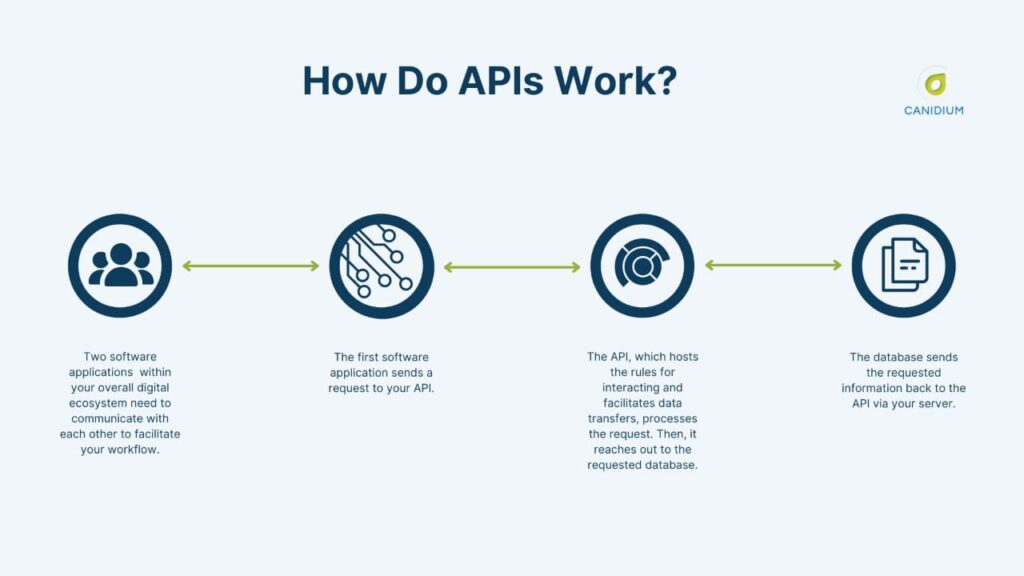
To build a truly flexible digital ecosystem around APIs, your architecture should incorporate a few core components.
Modular Architecture & Microservices
At the heart of API-first ecosystems lies a modular design where each microservice encapsulates a specific business domain or capability. Instead of one large, monolithic codebase, you get a collection of small, autonomous services that communicate via APIs. That modularity allows replacing, upgrading, or scaling individual parts of the system without disrupting others.
Because services remain decoupled, teams can build new features by composing existing APIs, dramatically reducing redundancy and development overhead.
Interoperability & Standardised Interfaces
APIs ensure interoperability across different subsystems, platforms, and clients. Whether your front-end uses JavaScript, a mobile app uses Swift or Kotlin, or a partner integrates via Python, they all talk to the same API contract, enabling seamless communication. This standardisation also makes integration with third-party services straightforward, supporting hybrid architectures, external partners, and future extensions without heavy refactoring.
Security, Governance, and API Management
Since APIs expose data and functionality across internal and external boundaries, security and governance become critical. An API-first strategy typically embeds security from the outset by enforcing authentication, authorisation, encryption, and access control consistently across all endpoints.
Moreover, an API management platform or gateway becomes essential. It acts as a unified entry point, managing traffic, enforcing policies (e.g. rate limits), handling protocol translations, and shielding backend services from direct exposure.
A strong governance model ensures that API design, documentation, versioning, deprecation, and compliance adhere to organisational standards, preventing “spaghetti” solutions and technical debt.
Scalability, Performance, and Resilience
Because each microservice behind an API can scale independently, you gain flexibility to handle traffic spikes, load balancing, replica deployment, and fault isolation. You avoid the constraints of scaling an entire monolith for a single overloaded component.
Additionally, API-first enables fault-tolerant design: if one service fails, others remain unaffected — minimising downtime and improving reliability.
The Business Value: Why Organisations Should Care
Moving to API-first isn’t just a technical decision — it delivers strategic business advantages.
- Accelerated innovation and time-to-market. Teams can build quickly by leveraging existing APIs instead of rewriting common functionality from scratch. Parallel development means features roll out faster.
- Reduced cost and technical debt. Reusability and modularity cut down redundant work. Maintaining or updating one component no longer requires touching unrelated parts of the system.
- Greater agility to respond to change. Whether adapting to new channels (mobile, web, IoT), integrating with partners, or replacing legacy components, API-first enables you to pivot without wholesale rewrites.
- Improved collaboration across teams. With a shared API contract and documentation, product managers, front-end developers, backend developers, and QA teams align more easily, reducing miscommunication and speeding up delivery.
- Future-proof architecture. As technology evolves with new backend platforms, new client devices, and new third-party services, a well-designed API layer absorbs changes, preserving continuity for clients consuming those APIs.
Designing APIs for Flexibility, Reuse, and Longevity
Adopting API-first doesn’t merely mean “build APIs first.” It requires thoughtful design, standardisation, and governance.
- Define clear API contracts using industry-standard specification formats (e.g. OpenAPI/Swagger). That ensures consistency in naming, data formats, error handling, authentication, and documentation.
- Aim for reusability. Build APIs around broad business capabilities, not narrow use-cases — avoid “single-use” APIs that duplicate logic across projects. Reusable APIs reduce redundancy and accelerate future development.
- Make API consumer experience (developer experience) a priority. Provide clear documentation, sandbox or mock servers for testing, and consistent error-handling flows. That lowers friction for developers integrating with your APIs, reduces bugs, and speeds adoption.
- Plan for versioning and backward compatibility. As APIs evolve, maintain backward compatibility or provide versioned endpoints so existing consumers don’t break. That preserves trust and stability across systems
The Role of API Management
Implementing API-first strategy at scale requires more than good design — it calls for a robust API management infrastructure.
- An API gateway (or similar management layer) centralises request routing. It gives clients a single entry point. Behind that gateway, multiple microservices respond, but the complexity remains hidden from clients. This decoupling enables backend evolution without affecting clients.
- Beyond routing, the gateway handles cross-cutting concerns uniformly: authentication, authorisation, encryption, rate limiting, load balancing, caching, protocol translation, and data transformation — all under one roof. That ensures security, consistency, performance, and maintainability.
- API management also enables monitoring and analytics by tracking usage, performance, error rates, latency, and traffic patterns. Those insights illuminate which APIs drive value, which need optimisation, and which can be deprecated.
With this structure, organisations can govern APIs systematically, enforce compliance, and ensure the long-term health of their digital ecosystem.
Roadmap to Implementing an API-First Strategy
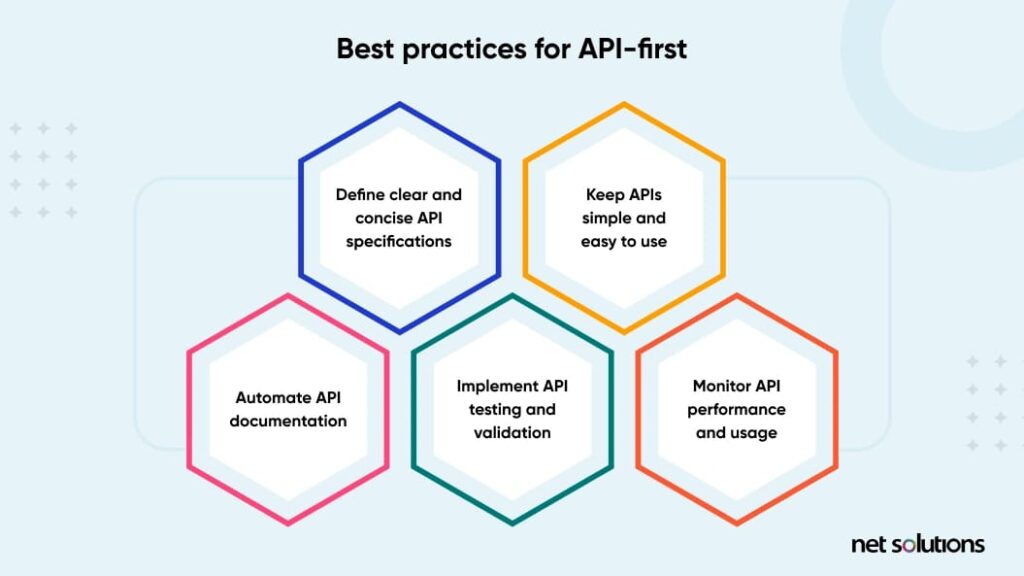
Transitioning to API-first isn’t merely a technical refactor — it often demands organisational and cultural change. Here’s a practical roadmap and the mindset shifts required:
- Assess your current ecosystem. Map out existing services, dependencies, integration points, and pain areas (rigidity, duplicated logic, integration bottlenecks).
- Define your business goals and API use cases. Identify which services or domains make sense to expose as APIs — internal services, partner integrations, external clients, microservices, legacy wrappers, etc.
- Establish architecture standards and API governance. Decide on specification formats (OpenAPI, GraphQL, etc.), naming conventions, versioning policy, security protocols (OAuth, TLS), documentation standards, and lifecycle (creation → versioning → deprecation).
- Design and build MVP APIs. Start with a few core, high-value services. Build API contracts first, then implement the backend. Provide mock servers or stubs so front-end or integration teams can start work early.
- Set up API management infrastructure. Deploy an API gateway or management platform. Enforce policies, authentication, rate limiting, logging, monitoring, and central access control.
- Monitor, iterate, and expand. Track usage, performance, and errors. Evolve APIs with careful versioning and backward compatibility. Deprecate obsolete APIs gracefully. Expand your API catalogue gradually.
Culturally, success requires breaking down silos. Product managers, backend teams, front-end developers, ops, and QA — everyone must align early around API contracts and governance. Teams must treat APIs as shared, long-lived assets (rather than disposable features).
Legacy systems deserve special attention. When migrating monoliths or legacy platforms, adopt a “strangler” pattern: wrap legacy functionality behind APIs, expose what you need, then incrementally replace backend implementations. Over time, legacy parts fade away, replaced by modular, maintainable services, all without disrupting clients.
Measuring Success: How You Know API-First Is Working
Shifting to an API-first architecture likely costs effort and discipline, but the payoff can be significant. To ensure you capture value, use metrics. Some key indicators:
- API adoption rate (internal teams using APIs, external clients/partners integrating)
- Time-to-market for new features or services (how fast you deliver new functionality)
- Reusability rate (percentage of new features built with existing APIs)
- System uptime, error rates, and latency — showing performance, scalability, and reliability benefits
- Developer satisfaction/onboarding time — how easily new developers or teams adopt the ecosystem
- Business metrics — revenue generated via partner integrations, API monetisation, reduced maintenance cost, faster internal delivery
Future Trends & Why API-First Strategy Remains Essential
The digital world keeps accelerating. As businesses adopt microservices, cloud-native infrastructure, multi-channel delivery (web, mobile, IoT), third-party integrations, partner ecosystems, and even AI-powered services, the demand for flexible, composable architectures only grows.
An API-first foundation prepares you for:
- rapid substitution of backend technologies
- integration with external partners
- scalable, distributed, cloud-friendly architectures
- real-time event-driven systems and asynchronous communication models
- changes in business models (e.g. exposing APIs as monetizable products)
By decoupling the interface from the implementation, API-first ensures your architecture evolves without breaking clients. Your ecosystem becomes modular, adaptable, and resilient — capable of morphing to meet future needs.
Conclusion
A truly flexible digital ecosystem demands more than one-off integrations or quick patches. It requires architecture built around modularity, interoperability, governance, scalability, and long-term thinking.
An API-first strategy delivers just that. By putting APIs at the heart of design, you create reusable, platform-agnostic building blocks. You give teams the freedom to innovate in parallel. You build systems that scale, adapt, and endure.
For modern enterprises facing evolving requirements, such as new channels, faster innovation cycles, partner networks, cloud migrations, and changing client expectations, API-first strategy isn’t optional. It becomes the backbone of future-ready digital architecture.