
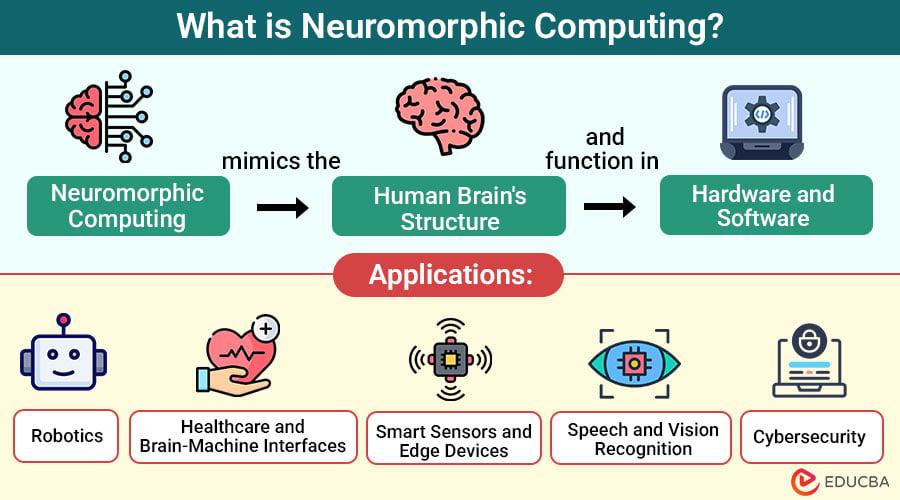
Neuromorphic computing rewrites how machines compute by copying the brain’s event-driven, parallel, and energy-efficient tricks. Web developers still design around request–response patterns, REST and GraphQL endpoints, and GPU-accelerated inference in the cloud. Neuromorphic systems, however, let us move intelligence closer to users. They sense events, reason in real time, and learn using smaller power budgets. This article translates neuromorphic concepts into concrete opportunities, patterns, and pitfalls for web development teams, and points to where you can start experimenting today.
What is Neuromorphic Computing?
Neuromorphic computing implements computation using neuron-like units that emit time-coded spikes, and synapse-like connections that route those spikes. Engineers design hardware and software to run spiking neural networks (SNNs), which differ from conventional deep nets because they operate on discrete events (spikes) and exploit temporal dynamics for computation. Researchers and industry players present neuromorphic systems as an alternative to von Neumann CPUs and GPU-centric AI for workloads that need ultra-low power, real-time reaction, and local adaptation.
Web apps have become more interactive, real-time, and distributed: think collaborative editors, AR/VR experiences in the browser, sensor-driven UIs, and privacy-sensitive personalization on mobile devices. Neuromorphic chips run certain perception and anomaly-detection tasks using orders of magnitude less energy than conventional processors, and they process inputs as events rather than as continuous streams. This is a natural fit for event-driven web architectures and edge-first design. In short, neuromorphic tech can reduce latency, cut cloud costs, and enable smarter clients for always-on features.
Hardware, Tooling, and the Current Ecosystem
You will encounter three practical tiers:
- Research neuromorphic chips and systems. TrueNorth demonstrated early large-scale neuromorphic hardware with around one million simulated neurons and very low power consumption. Intel followed up with the Loihi family. Loihi 2 and systems built from many Loihi chips push programmability and scale, and Intel pairs hardware with an open software framework called Lava. These platforms support research-grade SNNs and on-chip learning experiments.
- Neuromorphic simulators and APIs. Researchers use specialised simulators and frameworks to design SNNs, test synaptic plasticity rules, and profile workloads before mapping them to hardware. Open-source software, such as Lava and community-driven tools, lets developers prototype algorithms on CPUs/GPUs before deploying to neuromorphic hardware.
- Edge and hybrid systems. Vendors and labs explore combining neuromorphic chips with conventional microcontrollers or tiny SoCs to build event-driven edge nodes that feed web services or act autonomously. These hybrid models matter most to web developers because they define how a neuromorphic node integrates with HTTP/WebSockets/Edge CDN workflows.
How Neuromorphic Ideas Map to Web Architecture
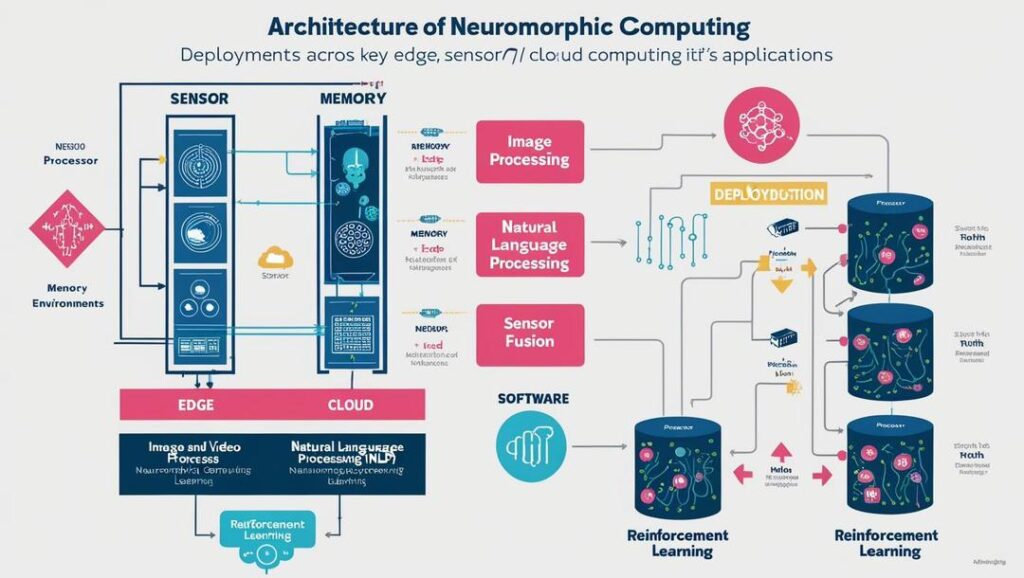
Replace vague metaphors with explicit patterns. Here are five ways to integrate neuromorphic components into modern web systems:
- Event-first clients. Treat user actions, sensors, and network changes as discrete spikes. Rather than polling, attach a lightweight SNN at the client or gateway to synthesise events into higher-level signals (e.g., “user intent: switch to reading mode”) and push only those distilled events to the server.
- Local, continuous monitoring. Deploy tiny neuromorphic modules at the edge to monitor UX metrics (frame drops, micro-interactions) or device telemetry for anomalies. The module raises a spike to the server only on meaningful changes, drastically reducing telemetry volume and enabling faster mitigation.
- Adaptive progressive enhancement. Let a neuromorphic agent customise UI complexity locally. The agent assesses device energy, latency, and user habits via spiking activity and toggles features without round-trip latency or heavy cloud inference.
- Privacy-first personalisation. Perform personalisation signals on-device with SNNs that learn incrementally from user events. The client shares only aggregated spike summaries with the server, preserving privacy while enabling cross-device coordination.
- Hybrid pipelines. Use neuromorphic nodes for front-line filtering and conventional neural nets in the cloud for heavy-duty tasks. The neuromorphic layer handles prefiltering, event compression, and urgent decisions; the cloud layer performs batch learning, heavy inference, and model updates.
Each pattern fits naturally into event-driven stacks and serverless/edge platforms. You still use the web’s transport standards (HTTP/2, WebSockets, WebRTC), but you reduce data and latency by handling meaningful cognition at the edge.
Concrete cases where neuromorphic tech works for web apps
Below, I detail specific, realistic scenarios and explain why neuromorphic solutions add value.
Real-time UX smoothing and attention detection
Browsers struggle to sense subtle shifts in user attention without constant telemetry. A small SNN on the client can fuse pointer motion, viewport focus, and timing into spikes that represent “user distracted” or “user engaged.” When the node detects distraction, it sends a short event to the server to adapt content (summaries, reduce video bitrate, or pause live updates) — saving bandwidth and improving perceived performance.
Low-power always-on features (e.g., voice activation)
Web-based voice assistants and always-on microphones drain battery when they stream audio continuously. A neuromorphic preprocessor can run on-device to detect wake-word-like patterns as sparse spikes and only send audio to cloud ASR when the agent signals a real event. That reduces continuous audio streaming, saving power and data.
Sensor fusion for AR/VR web experiences
WebXR sessions on mobile devices must fuse IMU, camera, and audio streams to maintain presence. SNNs handle asynchronous, jittery sensor inputs elegantly: they operate on events, react fast, and use little energy. Developers can offload low-latency correction and predictive rendering signals to neuromorphic modules, while the cloud renders heavyweight assets.
Fraud and anomaly detection on the edge
E-commerce and payment flows need fast fraud detection. A neuromorphic filter at the gateway identifies abnormal behavioural patterns in near real time — think spikes for improbable mouse movement clusters or rapid device-switch events — and triggers progressive security measures (challenge/2FA) before sending full transaction data to centralised fraud models.
IoT-driven web dashboards that scale
Industrial sensors generate huge event volumes. Deploying neuromorphic filtering nodes next to sensors compresses and classifies events into semantic summaries (normal, degrade, alert). The web dashboard consumes far fewer, higher-value events, which improves UX and reduces backend load. Research shows neuromorphic approaches can cut energy and bandwidth while maintaining detection performance for many sensor tasks.
Developer workflow: building and shipping neuromorphic-enabled features
You don’t need to become a neuroscience expert to add neuromorphic capabilities. Follow an iterative workflow similar to any emerging tech integration:
- Prototype in simulation. Implement SNN logic in a simulator or Lava. Test with recorded events from your app to validate signal quality and thresholds. Simulate power and latency constraints to estimate on-device viability.
- Map to hardware or optimised runtime. If the prototype proves useful, port it to a neuromorphic runtime (Loihi SDK, Lava, or a vendor runtime) or to an efficient event-driven fingered implementation on an MCU if hardware isn’t available.
- Integrate with web transports. Send compact spike summaries via WebSocket or HTTP/2 server-sent events. Use lightweight binary formats (CBOR, FlatBuffers) for minimal overhead.
- Monitor and iterate. Track false positives, latency, energy usage, and user impact. Neuromorphic systems often require careful observation of learning dynamics and plasticity rules during field use.
This path mirrors standard feature rollout but adds the extra step of hardware mapping and low-level event profiling. For research-grade chips (Loihi, TrueNorth), vendors provide software stacks and examples to help you map SNNs and estimate benefits.
Practical constraints and tradeoffs
Neuromorphic hooks offer dramatic wins for some workloads, but they present real tradeoffs:
- Availability and cost. Most neuromorphic chips live in labs or on limited-access platforms. Researchers access them through partnerships or cloud-based experiments; production-grade neuromorphic devices remain rare compared to ARM cores or microcontrollers. Expect hardware availability to improve slowly, but plan fallback implementations on conventional MCUs.
- Tooling maturity. Frameworks like Lava accelerate development, but the ecosystem lacks the polish you find in TensorFlow or PyTorch. Expect more manual tuning of spike encodings, plasticity rules, and learning schedules.
- Algorithm fit. SNNs excel at temporal pattern recognition, sparse signal detection, and continuous learning. They do not yet beat deep nets on every classification benchmark; map tasks carefully. Research shows SNNs perform well for imaging and event-driven sensing, but you must evaluate per problem domain.
- Dev skill gap. Your team needs to learn spike encodings, event-driven debugging, and energy profiling. Consider cross-training a small “neuromorphic sprint” team and use simulators before committing to hardware.
Security, privacy, and operational concerns
Neuromorphic nodes process local events and often handle sensitive signals (voice, motion). You must treat them like any compute element with privacy and security controls:
- Encrypt and authenticate event summaries during transit.
- Provide model update channels and integrity checks; neuromorphic modules that learn on-device need safe update strategies to avoid poisoning.
- Audit on-device learning to detect drift. Because SNNs can change behavior incrementally, implement monitoring to catch undesirable adaptation.
Treat neuromorphic nodes as first-class components in your devops pipeline: CI for SNN prototypes, telemetry for their outputs, and staged rollouts for plastic systems.
Where neuromorphic research points next
Several research threads will matter for the web:
- Better mapping tools and compilers. Projects aim to translate high-level network descriptions to efficient spiking versions automatically. Progress here will reduce manual effort.
- Hybrid neuromorphic–digital SoCs. Vendors will ship chips that combine neuromorphic cores with general-purpose processors. That hybrid model simplifies integration into existing devices and edge gateways.
- Standardised runtimes and web SDKs. Expect wrappers that expose neuromorphic primitives through JavaScript or WebAssembly to help web teams prototype in-browser or at the gateway. As runtimes emerge, web developers can test neuromorphic modules without specialised hardware.
- Domain-specific wins. Low-power always-listening sensors, industrial anomaly detection, and AR latency-reduction seem the likeliest early commercial wins. Academic reviews and recent hardware demos highlight these areas as the best fit.
Intel’s Loihi family and large neuromorphic clusters (e.g., multi-chip research systems) indicate vendor momentum. These systems prioritise programmability (Lava) and scale, which helps software teams move from experiments to production pilots.
Final verdict
Neuromorphic computing does not replace the cloud or conventional models. It complements them. Use neuromorphic modules where you need ultra-low power, continuous local monitoring, or millisecond reaction without round trips. For most web teams, the sensible path starts with simulation prototypes and small gateway or mobile pilots. When hardware access grows and runtimes improve, neuromorphic components will join the mainstream stack as compact, energy-smart signal sifters that let web apps behave more intelligently at the edge.