
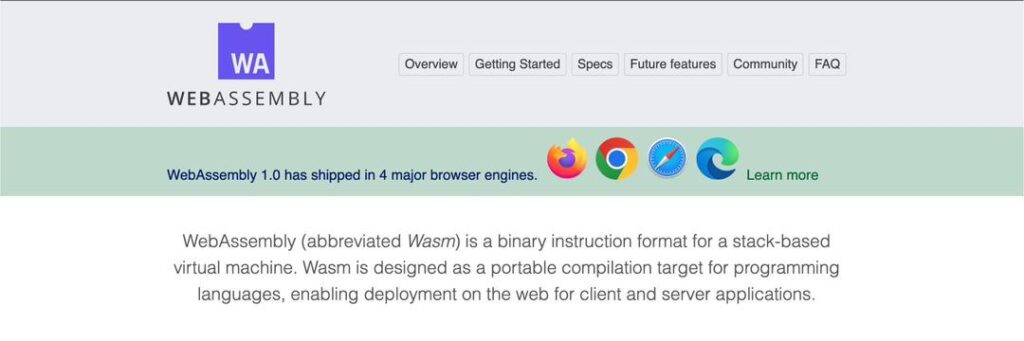
The web continues to absorb workloads that operate only on desktops and servers. Think complex design apps, real-time games, image and video editors, machine learning inference, and even parts of operating systems at the edge. JavaScript carried the web far beyond simple pages, but now performance has become the central design constraint. WebAssembly fills that gap by giving web apps a compact, fast, portable compilation target so that browsers can execute heavy code at speeds that approach native binaries. In short, Wasm helps the web run the kinds of apps developers used to build only for desktop machines.
This article explains what WebAssembly is, how it achieves near-native speed, its place in modern stacks, and where the technology is headed next.
What WebAssembly actually is
At its core, WebAssembly defines a compact binary instruction format and a corresponding execution model for running code in host environments such as web browsers. Authors compile code written in languages like C, C++, Rust, Go, or AssemblyScript into WASM modules. Browsers (or other runtimes) load and run those modules inside a secure sandbox. That design delivers three immediate benefits: small download size, fast decode and startup, and an execution model that maps well to low-level code generation, collectively making Wasm fast.
Wasm does not replace JavaScript. It complements JavaScript. JavaScript still remains the most ergonomic way to interact with the DOM, orchestrate UI logic, and glue pieces together. Wasm plays the role of the specialised workhorse. It is the compute engine you call into when you need heavy math, media processing, or code that benefits from a systems language. In practice, well-designed web applications use both: JavaScript for UI flow and Wasm for performance-sensitive kernels.
How Wasm gets its speed
This is the engineering beneath the label. Wasm reaches near-native speed through a handful of deliberate design choices. I’ll highlight the ones that matter most when you build real systems.
- Compact binary format and fast parsing. Wasm uses a concise binary encoding designed for quick download and decode. Engines parse Wasm far more rapidly than equivalent JS source because they avoid expensive parsing and AST construction steps required by JavaScript engines. That reduces time-to-execution for large modules and makes complex apps feel snappier.
- A lower-level compilation target. Compilers translate high-level language constructs to Wasm’s instruction set, which is a much closer match to machine code than to JavaScript. That closeness enables engines to produce tightly optimised native code (via JIT or AOT pathways), thereby reducing interpretation overhead and facilitating faster numeric and memory operations.
- Predictable memory model. Wasm exposes a linear memory buffer to compiled modules and avoids automatic, language-level garbage collection by default. That explicit memory control removes surprises and gives native-style performance characteristics for workloads that manage memory deterministically. (The language toolchain influences the final behavior — e.g., Rust keeps ownership guarantees, while compiled VMs may add their own GC.)
- Sandboxed, safe execution. The runtime prevents arbitrary memory access and enforces isolation. That safety allows engines to optimize aggressively without exposing the host to memory corruption bugs, a key property for performance without sacrificing security.
Benchmarks and real-world performance

You will see two recurring claims about Wasm: some tests show Wasm closing the gap to native speeds, while others report sizable slowdowns. Both statements hold depending on the workload, the browser, and the toolchain.
Academic evaluations across the SPEC CPU suite found that Wasm sometimes runs significantly slower than native—on average 45% slower in Firefox and 55% slower in Chrome for that particular study—because certain low-level machine optimizations and platform integrations remain harder in a sandboxed environment. Those benchmarks highlight worst-case gaps when code relies heavily on OS features, syscall semantics, or pointer-heavy patterns that the Wasm environment cannot match exactly.
Yet many production examples tell the opposite story in real application contexts. Companies that port native C++ engines to Wasm often report dramatic improvements over pure JavaScript implementations. Figma re-engineered large parts of its rendering pipeline using C++ compiled to Wasm and cut load time substantially, which improved the perceived responsiveness of the app. For many typical browser workloads (image transforms, physics, codecs), Wasm outperforms JavaScript by a wide margin and gives “desktop-grade” responsiveness inside a tab.
So what explains the discrepancy?
Benchmarks that compare Wasm to native at the CPU-microbenchmark level emphasize raw instruction parity, syscall semantics, and certain low-level idioms that expose Wasm’s current gaps. In contrast, application-level workloads often benefit from Wasm’s faster decode, smaller footprint, and efficient numeric execution, producing near-native user experiences even when microbenchmarks show headroom. The takeaway is to measure your use case. Wasm shines for compute-heavy, deterministic tasks you can isolate into a module; it may not match native for system-heavy or pointer-intensive workloads without additional runtime features.
Where Wasm makes the biggest practical impact
WASM excels in concrete, demanding scenarios where JavaScript bottlenecks appear:
- Graphics and games. Game engines like Unity and Unreal export to Wasm/WebGL pipelines and deliver complex, interactive 3D content in the browser with acceptable frame rates for many use cases.
- Design and media editors. Tools that process large images, apply filters, or perform vector ops benefit from compiled C++ or Rust cores. Figma’s rendering pipeline demonstrated meaningful startup and rendering improvements once it adopted Wasm.
- Compression, codecs, and cryptography. Numeric tight loops and bit-level operations run far faster in Wasm than in JS alternatives.
- Machine learning inference. Running model inference in the browser reduces latency and privacy exposure. Wasm allows libraries to reuse optimized C/C++ or Rust kernels where JavaScript lacked comparable performance.
- Edge and serverless compute. Wasm runtimes outside browsers (more on this below) give quicker cold starts and tighter isolation than traditional containers for small microservices.
These are not theoretical wins. Developers port production engines to Wasm, and ship faster features to users. When designers need responsive editing and engineers need sub-second results, Wasm becomes the practical choice.
WASI and the universal runtime idea
Until recently, the web remained the primary home of Wasm. The WebAssembly System Interface (WASI) changes that story. WASI defines a modular set of system calls and standard interfaces so Wasm modules can perform file I/O, access clocks and randomness, and (in ongoing work) network operations in a portable, secure way. WASI lets you run Wasm modules on servers, at the edge, or embedded in devices without bundling a full native runtime. That portability transforms Wasm from a browser trick into a general-purpose, sandboxed runtime for polyglot services.
Edge providers and serverless platforms now adopt Wasm + WASI because modules start faster, consume less memory for small workloads, and enforce stronger isolation than running arbitrary container images. You can think of Wasm + WASI as “microVMs” for single responsibilities: tiny, portable, language-agnostic pieces you deploy safely across clouds and edge nodes.
Languages and toolchains
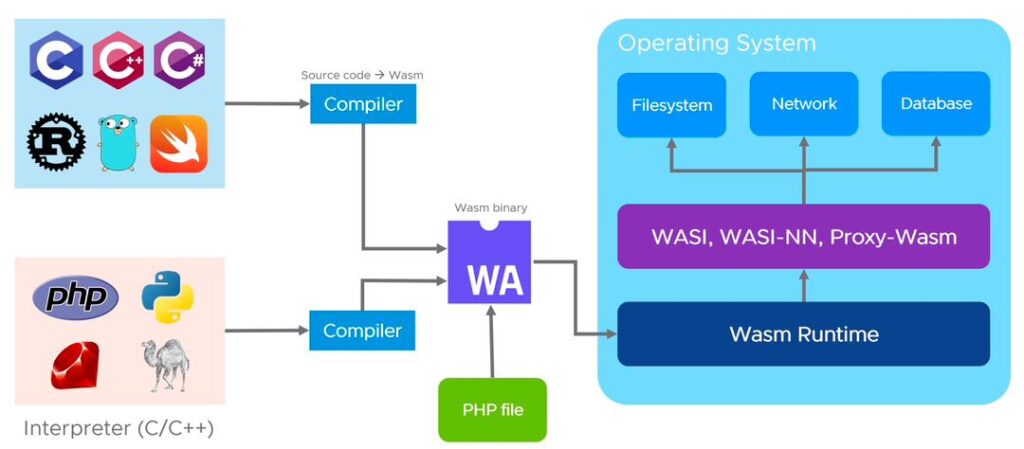
Wasm receives code from many sources. Each language brings different ergonomics and tradeoffs:
- Rust. Rust stands out because of its performance model, ownership-driven memory safety, and first-class tooling for Wasm. The Rust + wasm-pack ecosystem makes it easy to target both browser and non-browser runtimes, and many teams pick Rust when they need safety and speed.
- C/C++. These languages compile to Wasm via Emscripten or other toolchains. They enable teams to reuse large, battle-tested native codebases but require careful memory management and sandboxing awareness.
- Go. Go supports Wasm compilation for some use cases, but developers must weigh runtime size and GC behavior.
- AssemblyScript. AssemblyScript uses TypeScript syntax and targets Wasm; it gives JS teams an easier ramp when they need low-level performance kernels.
Tooling choices matter: wasm-pack, Emscripten, and modern compiler backends change the bundle profile, startup cost, and debugging experience. Choose the toolchain that fits your language, target runtime, and performance expectations.
Current limitations and common pitfalls
Wasm brings clear advantages but also practical limits you must accept or plan around:
- DOM access remains JavaScript’s domain. Wasm cannot directly manipulate the DOM; it must ask JavaScript to do so. That limitation pushes UI logic into JS and leaves computational kernels in Wasm.
- Debugging can feel rough. Source maps and language-level debuggers have improved, but debugging across Wasm and host JS still requires more maturity in tooling compared to traditional native stacks.
- Not all workloads benefit. Thin controllers or I/O-bound apps that mostly wait on the network won’t see gains from Wasm. The sweet spot sits in CPU-bound, deterministic tasks.
- Toolchain variance influences performance. The generated Wasm, linking choices, and compile flags change how well the engine optimizes the code. Profile and iterate.
What’s next?
Standards groups and engine vendors actively expand Wasm’s capabilities. The WebAssembly feature matrix and W3C working group roadmap list canonical improvements under development: threads with shared memory, SIMD instructions for vector math, garbage-collected object support for better GC language interop, interface types and the component model for easier cross-language calls, and other ergonomics that help a broader set of languages target Wasm. These features will shrink friction for languages with GC (like Java or C#) and enable faster access patterns for complex data.
WASI continues to evolve, adding standardized host capabilities so Wasm modules behave like portable microservices. Cloud and edge vendors build on WASI to run secure, fast functions with predictable startup and lower resource overhead than full containers. That trend could reshape how teams deploy and scale small, critical services.
The net effect: Wasm will grow from a niche performance technique into a mainstream runtime option for both client and server workloads.
Practical checklist for when and how to adopt Wasm
If you plan to evaluate or adopt Wasm, use this practical checklist:
- Measure first. Benchmark the real workload in JS. If a clear CPU hotspot emerges, Wasm likely helps.
- Pick a language and toolchain that fit your team. Rust offers safety and a strong Wasm story; C++ eases porting; AssemblyScript simplifies adoption for TypeScript teams.
- Design clear APIs. Minimise cross-boundary calls. Keep the Wasm surface small and focused.
- Optimise memory handling. Reuse buffers, avoid frequent allocations across the JS/Wasm boundary.
- Profile in target browsers and devices. Performance characteristics vary across engines and mobile hardware.
- Plan for security and supply-chain audits. Treat Wasm modules as first-class artifacts in CI/CD checks.
Follow these steps and you’ll reduce surprises and sharpen the performance wins.
Final thoughts
WebAssembly does something simple yet profound. It gives web developers a predictable, portable, and fast compilation target that runs within the browser or any host that implements its runtime. That capability enables teams to ship experiences that used to belong to native apps , such as heavy editors, complex games, and specialized compute, directly inside the browser with much of the code reuse and engineering discipline of native development. You will still use JavaScript for DOM and UX orchestration, but when the work becomes heavy, Wasm gives you a near-native engine to call.
Adopting Wasm does not guarantee instant miracles. You must pick the right workloads, use appropriate toolchains, and measure. But when you find the fit, Wasm changes the conversation: the web no longer suffers from a strict performance ceiling. It gains a new class of engines that push the web toward desktop capability, tighter serverless units, and a future where language choice no longer limits where code can run.